Before I Tell You About the Day, Let Me Tell You About the Months Before It
People who haven't been to a design school have a romantic idea of what it looks like. Studios bathed in natural light, students casually sketching brilliant ideas over coffee, creative epiphanies before lunch. The reality is different — and I say that as someone who chose this path, loves this path, and would choose it all over again.
The reality is 2 AM in the studio, your third physical model collapsed because the balsa wood was too thin, and you're rebuilding it from scratch because jury is in six hours. It's a render that won't export correctly. It's a fabric sample that doesn't drape the way your sketch promised. It's a user flow diagram that made perfect sense in your head and makes zero sense on screen. It's the moment your faculty says 'start over' on week eight of a twelve-week project — and you understand, after the initial despair, that they were right.
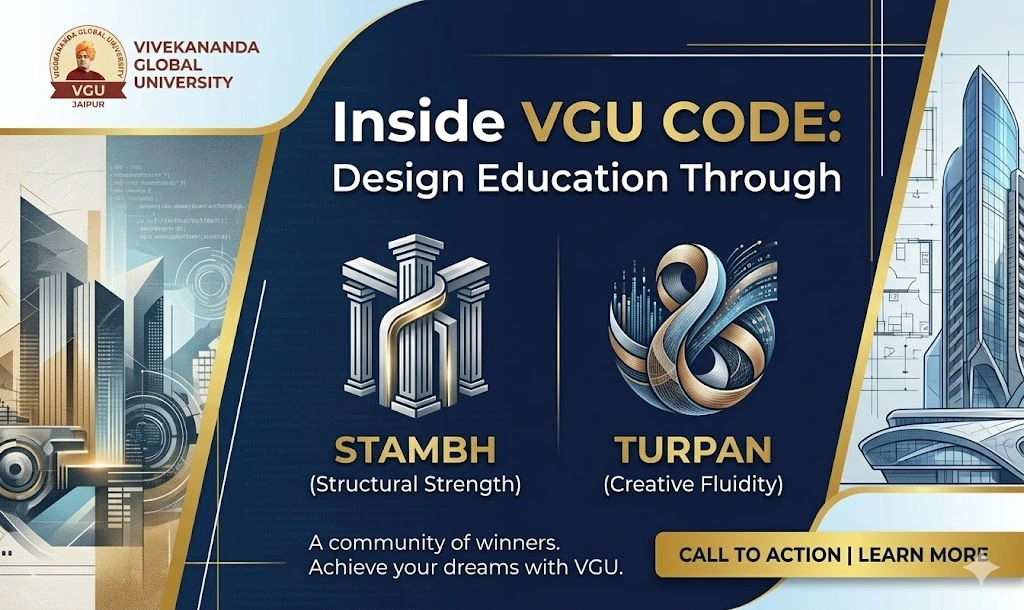
That is the real life of a design school. And STAMBH & TURPAN 2026 — VGU's flagship annual confluence of Design and Architecture held on June 6 at Clarks Amer, Jaipur — was the day all of that effort finally met the world.
❝ Design school doesn't teach you how to make beautiful things. It teaches you how to think, fail, rebuild, defend, and ultimately — create things that matter. ❞
───────────────────────────────────────────────────────────────────────────
Architecture & M.Plan: When Buildings Begin as Arguments
The B.Arch Journey — Five Years of Learning to Think in Space
Architecture is the longest undergraduate design journey in India — five full years. By the time a B.Arch student at CODE reaches thesis year, they have survived structural drawing marathons, site documentation field trips at 6 AM, sustainable design studios where everything had to be net-zero-justified, and urban design projects requiring them to understand cities they had never visited. The thesis is not the beginning of serious work. It is the accumulation of it.
For our final-year Architecture batch, the thesis topic selection happened months before STAMBH 2026. The brief was open-ended but anchored in real-world need: identify a typology, a site, a problem, and propose a design solution rigorous enough to withstand professional scrutiny. The students who chose the 100-bedded hospital infrastructure projects were responding to one of India's most urgent design challenges — a healthcare architecture gap that is only growing as urban populations expand and tier-2 cities demand tertiary care facilities.
The preparation was relentless. Site analysis. Climate data mapping. Patient flow modelling. Structural system selection. Building services integration. GRIHA compliance documentation. Accessibility ramp calculations. Fire safety layouts. These aren't optional additions in an architecture thesis — they are the architecture thesis. And in the weeks leading up to STAMBH, the studio was never empty past midnight.
What the Jury Demanded
At STAMBH 2026, Architecture juries included practising registered architects and urban design consultants. The questions weren't gentle. 'Why this site and not the adjacent parcel — what does your site choice argue for programmatically?' 'Show me your section through the ICU wing — where is the natural light strategy, and how does it balance infection control?' 'Your circulation model assumes patients and staff share a corridor at this node. How does that work at peak occupancy?' These are not academic questions. They are the exact questions a project would face in a real DPR review.
❝ My jury member leaned forward and said: 'This is a competent project. Now tell me what makes it a necessary one.' I didn't have a clean answer. But I've been thinking about it ever since — and that's exactly the point. ❞
M.Plan Students — Designing Cities, Not Just Buildings
VGU's M.Plan students brought a different register entirely to STAMBH 2026. Where B.Arch thesis is building-scale, M.Plan work operates at the city and region scale — land use frameworks, mobility corridors, heritage zone management plans, affordable housing distribution models, and mixed-use development strategies for peri-urban Rajasthan.
The M.Plan students are typically lateral entrants — graduates from Architecture, Civil Engineering, Geography, or Urban Studies who chose to specialise in planning as a research and policy discipline. At VGU, the M.Plan programme sits within a city that is itself a planning case study: Jaipur's heritage buffer zones, its expanding ring roads, its informal settlements pushing against the walled city's UNESCO boundaries, its Smart City Mission implementations, and its real estate booms along NH-48 are all live urban phenomena that M.Plan students can study, map, and propose for.
At STAMBH 2026, M.Plan thesis presentations were reviewed by urban planners and infrastructure consultants whose daily work involves exactly these decisions. The feedback was precise, professional, and — for students who had spent twelve months on research nobody outside academia usually reads — it was energising.
───────────────────────────────────────────────────────────────────────────
Interior Design: The Discipline That Lives Between the Drawing and the Room
B.Des Interior & Product Design — Where Everything Is Felt Before It Is Seen
Interior design students at CODE inhabit a peculiar creative tension: you are designing spaces that exist physically but must be conveyed conceptually. Every mood board, every material palette, every light fixture specification, every furniture layout has to communicate to someone who hasn't walked into the space yet. The discipline trains you, systematically, to make the invisible visible.
In the semesters leading up to STAMBH 2026, Interior Design students worked on projects spanning residential design, commercial retail spaces, healthcare interiors, hospitality environments, and exhibition design. The studio days were long — not because faculty demanded overtime, but because interior design problems don't resolve at 6 PM. A circulation issue in a 3,000 sq ft commercial floor plate can consume three days. Getting the proportion of a feature wall right in a hospitality lounge — balancing material weight, lighting temperature, and human scale — is not a two-hour exercise.
CODE's infrastructure supported this process: the Maker's Space lab, the Material Museum, the Carpentry Lab, and the Computer Labs running AutoCAD, SketchUp, 3ds Max, and Revit were all part of the everyday toolkit. But the most important tool was the faculty critique — the mid-studio interruption where a senior designer looks at what you're building and asks you to justify every single choice.
The Open Jury for Interior Design at STAMBH 2026
Interior design juries at STAMBH were portfolio-integrated — which meant students didn't just present one project; they presented a body of work curated to demonstrate growth, range, and professional readiness. The jury panel included practising interior architects and design consultants who work on the exact typologies students had studied. The conversation moved fast. 'Walk me through your material specification for this healthcare waiting zone — why polished concrete in a space designed to reduce patient anxiety?' 'Your lighting plan here shows warm white fixtures throughout, but this is a retail environment. What's your rationale for not using accent lighting in the product display zones?' Real questions. Industry standard. STAMBH standard.
India's interior design market is projected to reach USD 65 billion by 2031, driven by real estate expansion, urban development, and growing demand for designed commercial spaces.
───────────────────────────────────────────────────────────────────────────
Product Design: From Studio Prototype to Flea Market Reality
The Making Culture at CODE
If there is one discipline at CODE that most dramatically collapses the gap between idea and outcome, it is Product Design. You can't sketch your way through a product design degree. At some point, the idea has to become a physical thing — something you can hold, test, break, rebuild, and sell. The studio culture for Product Design at VGU is built around this imperative.
Product Design students work across the Metal Fabrication Lab, Carpentry Lab, Art & Craft Lab, and 3D rapid prototyping facilities. A single product might go through eight material iterations before the team agrees it's ready to present. The ergonomic laptop stand that appeared at the STAMBH flea market? That was six weeks of handle height testing, weight-to-stability ratio calculations, and finish experiments before it became the clean, sellable object on display. The multi-use jewellery organiser with modular compartments? Four material combinations were trialled before the final mix of sustainable birch ply and powder-coated steel was locked.
This is the learning that design school uniquely offers: the confrontation between what you imagined and what physics, materials, manufacturing tolerances, and user behaviour will actually allow.
The STAMBH Flea Market — The Most Honest Jury There Is
Nothing in my four years at CODE prepared me for how much the flea market would teach me in a single afternoon. Nearly 180 student-designed products were on display — and the 'jury' was a crowd of real buyers making real purchasing decisions.
Let me be specific about what was on show, because the breadth of it matters:
▸ Utility Products: Multi-use jewellery organisers with modular compartments designed for evolving personal collections
▸ Workspace Products: Ergonomic laptop stands from sustainable materials, optimised for Indian desk-work postures
▸ Lighting Design: Resin lamps playing with light refraction through embedded botanical and mineral elements
▸ Craft Innovation: Handcrafted incense holders drawing from Rajasthani craft traditions, reinterpreted in contemporary form
▸ Sustainable Living: Sustainable home textiles using natural dyes and upcycled fabric
▸ Corporate Gifting: Roman-themed corporate gift sets — a product line with a clearly defined B2B market
▸ Cultural Products: Bharat Battle and Guess The God — cultural card games merging Indian heritage with contemporary game design
▸ Space Solutions: Foldable accessories organisers designed for compact urban living
I watched people pick up products, put them down, pick them up again. I watched a buyer negotiate on the Roman gift set — not because they were doing a student a favour, but because they wanted it for their corporate diwali gifting. I watched a child immediately understand how Bharat Battle worked without any instruction. That child's instinct was worth more as design feedback than twelve studio critiques combined.
❝ A stranger bought my product. Paid for it with their own money. That is the validation no mark sheet can give you. ❞
M.Des Product Design — The Postgraduate Lens
M.Des Product Design students at VGU brought a research-driven depth to the flea market that set them apart from their undergraduate peers. Postgraduate product design in India is about design thinking at the systemic level — understanding supply chains, sustainability certification frameworks, circular economy principles, and DFM (design for manufacturability) constraints that most undergraduates are still learning.
M.Des students presented products backed by written design rationale: user research methodologies, material lifecycle analyses, manufacturing cost modelling, and market positioning frameworks. Their jury sessions were more seminar than showcase — and the industry jury members engaged accordingly, asking questions about scale, licensing, and whether any of the products had IP protection.
India's creator economy is now a core strand of the national $5 trillion economy ambition. Budget 2026 announced investment in creative infrastructure across 500 institutions, signalling serious state commitment to design and creative industries.
───────────────────────────────────────────────────────────────────────────
Fashion & Textile Design: The Long Road to the Runway
What Fashion Students Actually Do for Eight Months Before the Show
There is a popular misconception about fashion design students — that they spend their time making glamorous things in comfortable studios with good lighting. The truth is that fashion students spend most of their time at a cutting table, arguing with a sewing machine, unpicking a seam they've made three times because the grain is slightly off, or staring at a drape that hangs beautifully in concept but refuses to translate in fabric.
In the months leading up to TURPAN 2026, the Fashion & Textile studio at CODE was in a state of productive controlled chaos. Students were working simultaneously on: concept development and mood boarding, fabric sourcing and sampling, pattern drafting, toile construction and fitting, surface treatment (hand embroidery, block printing, heat transfer, natural dyeing), final garment construction, accessory design, and collection presentation strategy. All of this had to cohere — every garment in a collection had to speak the same creative language, tell the same story, and hold up to professional scrutiny.
CODE's Textile Lab and Pattern Making Lab were occupied continuously in the six weeks before TURPAN. The studio smelled permanently of fabric and determination. Students traded sleep for seam quality. Faculty critique sessions were intense — not because they were unkind, but because the runway is an unforgiving format, and professional fashion judges don't grade on effort.
TURPAN 2026 — The Runway as Professional Debut
By the time the TURPAN fashion show began that evening at Clarks Amer, the students who walked their collections down the runway had earned every step. The show was professionally curated — lighting, music, staging, and choreography at a standard that would not look out of place at a state-level fashion week.
Collections ranged across: traditional Indian craft revival (ikat weaves reimagined as contemporary silhouettes, Rajasthani block print elevated to eveningwear), performance and technical wear, digital textile print explorations, sustainable and upcycled fashion, and bold cultural identity statements that fused India's visual heritage with global fashion vocabulary.
CODE VGU students have previously showcased at Lakme Fashion Week — and the TURPAN standard makes that trajectory visible. The collections on the runway weren't student exercises. They were the first chapters of designer careers.
The Fashion Jury — Commercial Meets Creative
The fashion jury for TURPAN 2026 included working fashion designers, textile industrialists, and buyers — people who stock shelves and commission collections for real commercial markets. Their evaluation framework was dual: creative originality and market viability. 'Is this a collection that could anchor a pop-up store in Bombay's Bandra market?' 'Is this a design language that scales beyond five pieces?' These were real commercial questions that separated TURPAN from any ordinary college fashion show.
Three students from our batch received direct expressions of interest from buyers and design studio representatives during the event. Not promises — actual conversations with specifics: quantities, timelines, and next steps. For them, TURPAN was the first transaction of a professional career.
M.Des Fashion Design — Where Research Becomes Collection
M.Des Fashion Design students at VGU operate at the intersection of research, craft, and commerce. Their thesis collections at TURPAN 2026 were accompanied by written design dissertations — research documents that contextualised each collection within broader conversations about sustainability in Indian textile manufacturing, the economics of handloom preservation, the semiotics of contemporary Indian fashion identity, or the UX of fashion retail in a post-pandemic consumer landscape.
The M.Des students' jury sessions reflected this depth. Jury members asked questions about research methodology, about the gap between the academic argument and the collection execution, about what the designer intended to change in the industry. These were graduate-level conversations — and the students held them.
❝ My M.Des thesis collection wasn't just about the clothes. It was an argument — about who gets to tell the story of Indian craft, and in whose voice. The jury understood that. That felt like the whole point. ❞
───────────────────────────────────────────────────────────────────────────
UI/UX & Communication Design: The Screen Is the Studio
What UX Students Spend Their Time Building
UX and Communication Design students at CODE operate in a discipline that is simultaneously the most in-demand creative field in India today and the most misunderstood. There is a common assumption that UX is a tech career with design aesthetics bolted on. What CODE actually trains is something far more demanding: the ability to understand human behaviour, translate it into structured information architecture, and then express it through interfaces that are both beautiful and functionally invisible.
The thesis preparation for UX students involves user research phases — surveys, contextual interviews, usability testing, persona development, journey mapping — before a single screen is designed. The portfolio-ready capstone project at STAMBH 2026 wasn't a beautiful app prototype. It was a full design system: research documentation, problem framing, information architecture diagrams, interaction flows, wireframes, high-fidelity prototypes, and usability test results. That is what serious employers in 2026 look for. Being fluent in Figma is the entry ticket, not the differentiator.
The UX Jury at STAMBH 2026 — Thinking, Not Just Making
UX jury members at STAMBH 2026 came from product companies, UX consulting firms, and digital experience agencies. Their evaluation was systematic: 'Walk me through your user research methodology — how did you validate that this was a real problem before you started designing a solution?' 'Show me your information architecture. How does a first-time user who hasn't read your onboarding flow navigate to this feature?' 'You've tested with five users. What would change in your design if the sample were 500?'
These questions separate students who understand UX from students who have learned a design tool. The CODE curriculum — with its emphasis on design thinking, problem framing, and user-centred methodology — prepares students for exactly this level of scrutiny. Several UX graduates at STAMBH 2026 received placement leads from companies with active UX hiring pipelines — including firms operating in edtech, fintech, and healthcare sectors where Indian UX talent is most urgently needed.
In 2026, being proficient in Figma alone is not enough. Employers demand designers who think like product architects — combining user research, systems thinking, and interaction design into a unified practice.
───────────────────────────────────────────────────────────────────────────
The Jury That Mattered: 150+ Practitioners, Zero Ceremonial Attendance
Design education is only as strong as the industry mirror it holds up to student work. A jury of internal faculty telling students what they already know is not a jury — it is a formality. STAMBH & TURPAN 2026 was structured as the opposite of a formality.
Over 150 architects, designers, planners, fashion designers, UX professionals, creative entrepreneurs, and industry leaders contributed throughout the day. They came to work. And the diversity of their expertise meant that every discipline at CODE had evaluators who understood the precise standards their field demands.
Distinguished Voices at STAMBH & TURPAN 2026
▸ Philip Thomas: Country Head – India, World Design Council | 30+ years in media, design education, and creative skill development | Evaluated design work against global industry benchmarks and challenged students on professional deployability
▸ Rashmi Bhardwaj: Distinguished alumna of NID Ahmedabad | Brought the rigor of India's premier design institution to portfolio reviews | Pushed students on craft quality, conceptual integrity, and design language coherence
▸ Sunil Verma: Transportation Designer and Design Educator | Specialised lens on materiality, ergonomics, and sustainability trade-offs in product and industrial design
▸ Ritvik Yadav: Founder & CEO, Khageshvara Aviation Technology Pvt. Ltd. | Represented design-led entrepreneurship | Asked the question every student needs to hear: 'What real problem does this actually solve, and can a business be built around it?'
▸ 150+ Industry Professionals: Architects, Urban Planners, Fashion Designers, Textile Industrialists, UX Leads, Communication Design Directors, Retail Buyers, and Creative Entrepreneurs from across India — all actively engaged in evaluation, mentoring, and portfolio review throughout the day
What distinguished this jury panel was not just their individual credentials but their active participation. They didn't sit at evaluation tables waiting for students to approach them. They walked the spaces, initiated conversations, pointed to work on the walls, asked follow-up questions across disciplines. Philip Thomas' comment to an architecture student about how the World Design Council thinks about 'design for equity' sparked a twenty-minute conversation that included three other students who had overheard it. That is the ecosystem effect — unplanned, valuable, and impossible to manufacture in a classroom.
❝ The best jury feedback I received that day wasn't about my work at all. It came from overhearing Philip Thomas talk to an architecture student about what design-for-public-benefit actually means. I've been thinking about it for every project since. ❞
───────────────────────────────────────────────────────────────────────────
The Weeks Before STAMBH: What No One Photographs
Social media shows you the runway. The jury presentations. The products gleaming under event lighting. The graduation smiles. It doesn't show you what came before.
It doesn't show the fashion student who unpicked and re-stitched the same collar fourteen times because the fall wasn't sitting right. The architecture student who rebuilt their physical model at 4 AM after it collapsed two days before STAMBH, sourcing new balsa from a craft shop that opened at 7 AM. The product designer who scrapped a six-week prototype when they realised the hinge mechanism didn't work at the stress points users would actually apply. The UX student who redesigned their entire information architecture in the final two weeks because user testing revealed a navigation assumption that wasn't holding up.
It doesn't show the interior design student who stayed in the studio until the cleaning staff arrived every morning for a week straight, because the 3D visualisation had to be perfect before jury day. Or the M.Des student who rewrote their design dissertation's conceptual framework chapter in the final ten days because a visiting lecturer asked a question that exposed a gap in the argument.
That is the real life of a design school. Not the glamour of the showcase, but the invisible work that makes the showcase honest.
What Design School Actually Grooms You For
▸ Structured thinking under pressure — the ability to hold a complex brief in your head and make progressive decisions without losing coherence
▸ Physical and digital craft skill — the material intelligence to understand what tools, materials, and processes your ideas actually require
▸ Professional communication — the capacity to present your work, defend your choices, and receive criticism without losing your perspective
▸ Industry standard — an internalised benchmark for what 'good enough' actually means in a professional context, not just an academic one
▸ Entrepreneurial instinct — the flea market, the runway show, the placement conversations all build the commercial intelligence that separates designers who make things from designers who build careers
▸ Peer learning — in a studio environment, you absorb as much from watching a classmate solve a problem as from any lecture
───────────────────────────────────────────────────────────────────────────
Placements, Internships & Real Outcomes: What STAMBH Actually Delivered
The Creative Placement Drive at STAMBH 2026 was not a careers fair with brochures. It was a live marketplace of talent and opportunity — and by the end of the day, it had moved outcomes that a normal placement process takes weeks to achieve.
Over 150 creative job roles were on offer across architecture, interior design, product development, fashion, UX, communication design, planning, and emerging digital sectors. Employers from Jaipur, Delhi, Mumbai, and Ahmedabad were present — a geographic spread that reflects the distributed nature of India's design industry in 2026.
What Actually Happened on the Day
▸ Architecture students with healthcare and public infrastructure projects received interest from planning consultancies working on similar typologies
▸ Product Design students with market-validated flea market products were approached by buyers and retail design firms
▸ Fashion & Textile students received expressions of interest from buyers and design studios following the TURPAN runway
▸ UX/UI students presented full design system portfolios to product companies actively hiring for interaction design roles
▸ Interior Design students with commercial and hospitality portfolios were engaged by firms working on Jaipur's rapidly expanding hospitality and retail sectors
▸ M.Des students received research and senior design role conversations beyond entry-level positions — their postgraduate depth opened a different tier of opportunity
CODE VGU's 450+ recruiter network and 92% placement support record didn't appear at STAMBH as a claim on a brochure. It appeared as actual professionals in the room, having actual conversations, leading to actual outcomes. That is the difference between a placement cell and a placement ecosystem.
For internship seekers — students in years two and three who came to observe and engage — the exposure was equally formative. Design internships in India in 2026 are genuinely competitive, and the difference between a student who walks into an internship application with a STAMBH jury conversation and portfolio feedback versus one who doesn't is measurable.
❝ I didn't just walk out of STAMBH with a job lead. I walked out knowing, for the first time, exactly what kind of designer I want to be. That clarity is worth as much as the offer. ❞
───────────────────────────────────────────────────────────────────────────
The Ecosystem STAMBH & TURPAN Built — And Why It Matters for Indian Design Education
India's creative industries contribute nearly 8% to total national employment. The country's design sector is growing across UI/UX, product innovation, fashion, architecture, interior design, and communication design — and the demand for skilled creative professionals is outpacing supply.
The educational response to this gap cannot be more classrooms and more lectures. It must be more environments like STAMBH & TURPAN: immersive, industry-connected, portfolio-validating, placement-accelerating, and commercially grounding.
What VGU's CODE created on June 6, 2026 was not an event. It was a proof of concept for what design education in India can and should be: 327 graduating students, 42 parallel open juries, 150+ industry professionals, 180 products sold in a live flea market, a professionally executed fashion runway, 150+ placement opportunities, and postgraduate researchers presenting dissertation-level work to practitioners who will decide where the field goes next.
For younger students watching it unfold, STAMBH & TURPAN was a four-year education compressed into a single day — every discipline visible, every pathway illuminated, every professional conversation a data point about where they want to go.
For the industry professionals who came, it was the best argument available for why India's private design education ecosystem — when it is serious, rigorous, and industry-connected — is producing the creative talent the country needs.
And for those of us who stood in front of jury members that morning, walked the flea market that afternoon, and watched our classmates take the runway that evening — it was the day we stopped being students and started being designers.
❝ STAMBH & TURPAN isn't the end of design school. It's the beginning of everything you're going to do with what design school gave you. ❞