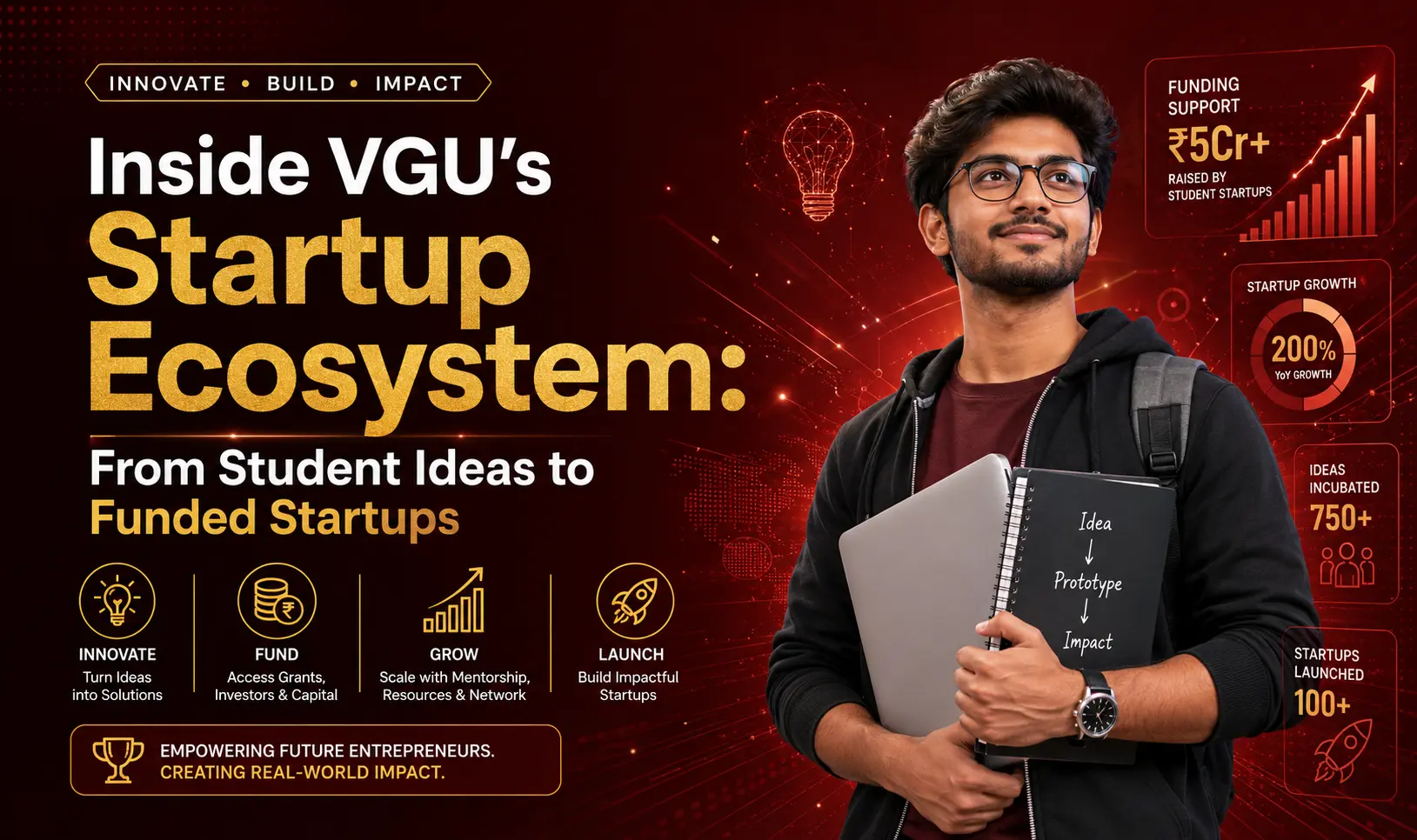
Quick answer: Vivekananda Global University (VGU) helps students build startup careers through a fully integrated innovation ecosystem-anchored by the ACIC-VGU Foundation (India's first Atal Community Innovation Centre in a private university) and the VGU Technology Business Incubator (VGU-TBI). Together they have incubated 160+ startups, generated ₹100 Cr+ in revenue, created 800+ jobs, and unlocked over ₹16 crore in government grants for student and grassroots founders.
If you've ever sat in a classroom with a startup idea quietly burning in the back of your head-wondering who would actually mentor you, where you'd build the prototype, and how you'd raise that first cheque-this blog is for you.
Here's how a campus in Jaipur is rewriting what "career after graduation" looks like.
The Old Story vs. The VGU Story
For decades, the script for an Indian student was simple: graduate, get placed, climb a ladder. Entrepreneurship was something you did after a corporate stint, or only if your family had money to lose.
VGU has been quietly tearing up that script.
Instead of treating startups as an extracurricular club, the university has woven incubation, mentorship, and early-stage funding directly into the academic journey. Students don't wait until graduation to "think about a business." They start solving real problems in their first year, build prototypes in dedicated labs, pitch to actual investors at on-campus demo days, and walk out- in many cases - with a registered company, a small revenue line, and a team.
This isn't a brochure claim. A recent YourStory feature on VGU described the campus as functioning "less like a traditional university and more like a founder pipeline." The numbers back it up.
What is ACIC-VGU Foundation?
ACIC-VGU Foundation stands for Atal Community Innovation Centre - Vivekananda Global University Foundation. It is established under the Atal Innovation Mission (AIM), NITI Aayog, the Government of India's flagship innovation body - and it holds a distinction that few campuses in India can claim:
ACIC-VGU is India's first Atal Community Innovation Centre set up inside a private university.
The mission is refreshingly grounded. Instead of chasing flashy SaaS clones, ACIC-VGU was built to reach innovators at the bottom of the pyramid - the artisans, designers, agri-entrepreneurs, and first-generation founders from Tier-2 and Tier-3 cities of Rajasthan who rarely get a seat at a Bengaluru pitch event.
What ACIC-VGU offers students and founders
6 prototyping labs - design studios, makers-space, fabrication, textile & apparel, and electronics
Co-working spaces and dedicated startup cabins on the VGU campus
50+ mentors from industry, academia, and the investor community
60+ active partnerships with government bodies, corporates, and ecosystem enablers
Funding access via Startup India Seed Fund Scheme (SISFS), MeitY GENESIS, DST NIDHI Seed Support, and HDFC Parivartan
Legal, IP, and compliance support through in-house advisors
200+ events conducted including bootcamps, hackathons, and demo days
In short: if a student has an idea, every block needed to convert that idea into a company - workspace, machines, mentors, money, market - is sitting on one campus.
VGU-TBI: The Deep-Tech Arm
While ACIC-VGU casts a wide, community-first net, the VGU Technology Business Incubator (VGU-TBI)-established in 2021 focuses specifically on technology-first ventures: software products, hardware innovations, AI, robotics, and deep-tech.
VGU-TBI offers incubated startups dedicated office space, high-speed connectivity, presentation facilities, and structured demo-day exposure with corporate partners aligned to IBM, Bosch, and Microsoft ecosystems.
The two incubators work together. A student with a deep-tech product gets channelled into VGU-TBI; a student building a sustainable textile brand, a craft-based D2C venture, or an agritech solution lands at ACIC-VGU. Either way, the founder is supported.
Real Student Founders, Real Outcomes
Numbers are persuasive, but founders are proof. Here are three stories that capture what's possible.
1. Kavadea - From College Idea to Funded Streetwear Brand
Founded in 2022 and formally incorporated on 6 July 2023, Kavadea is an internet-first streetwear brand for women and men, building bold, expressive fashion for the new generation. Co-founded by Reena Shekhawat, Kavadea operates in a space packed with 100+ active competitors - including Bonkers Corner and Urban Monkey-yet has carved out a steady growth path.
The breakthrough moment: Kavadea secured the Startup India Seed Fund through ACIC-VGU Foundation. In the founders' own words, what began as a simple dream has grown into a ₹1 million+ startup - a journey "made possible by the constant support of Vivekananda Global University and ACIC."
2. Core B Trailer - Engineering Real-World Mobility
The founder of Core B Trailer, a VGU alumnus, has built an innovative transportation solutions venture out of the incubation centre - a reminder that hardware and mobility startups, not just apps, can scale from a Jaipur campus.
3. Dream Note - When the Arts Become a Business
A renowned vocalist, songwriter, and composer - also a VGU alumnus and incubatee - built Dream Note, a music startup nurtured inside the VGU–ACIC ecosystem. It's a small but significant proof that "startup" at VGU isn't synonymous with "tech bro." Design, music, fashion, craft - they all count, and they all get capital and mentorship.
The Numbers That Tell the Story
How a Student Actually Becomes a Founder at VGU: The Step-by-Step Journey
This is the question every aspiring student-entrepreneur wants answered. Here's the honest, sequential map.
Step 1- Ideate inside the classroom
Through VGU's Transdisciplinary Project (TDP) model, students from engineering, design, law, management, and pharma collaborate on real-world problems. The university generates 1,000+ such projects every year - many of which become patentable prototypes or registered companies.
Step 2- Get matched to the right incubator
Idea fits art, craft, agri, fashion, lifestyle, sustainability, or social impact? ACIC-VGU Foundation. Idea fits software, hardware, AI, deep-tech? VGU-TBI.
Step 3- Validate inside Maker Spaces and Tinkering Labs
Use the prototyping labs, fabrication studios, and textile & design studios on campus to build a working v0.1 - without burning personal capital on equipment.
Step 4- Get a mentor (or three)
Tap the 50+ mentor network - industry founders, academics, IIT/BITS alumni, and active investors - to refine the product, sharpen the pitch, and avoid the obvious mistakes.
Step 5- Pitch at on-campus events
Shark Tank-style pitch competitions, Demo Days, the Student Innovator Program, and the flagship Gen-Next Bharat Startup Summit put student founders in the same room as investors and policymakers. The March 2026 summit alone hosted 250+ founders, investors, and senior officials including the CEO of MeitY Startup Hub.
Step 6- Apply for grants and seed capital
ACIC-VGU helps eligible founders apply to:
Startup India Seed Fund Scheme (SISFS) - up to ₹50 lakh
MeitY GENESIS - Gen-Next Support for Innovative Startups
DST NIDHI Seed Support Program - early-stage technology grants
HDFC Parivartan - social and impact-driven startups
Step 7- Scale with infrastructure, partners, and exposure
Continue using co-working, legal, IP, and marketing support while building B2B partnerships through VGU's network of 60+ ecosystem partners. Several founders cross the ₹1 Cr revenue mark while still affiliated with the incubator.
Why a Tier-2 City Like Jaipur Is Quietly Becoming a Startup Advantage
Jaipur isn't Bengaluru. It doesn't pretend to be. And that's increasingly the point.
VGU CEO Dr. Onkar Bagaria has spoken openly about education that prepares students "not just for today's jobs but for tomorrow's opportunities - particularly serving the needs of Tier-2 and Tier-3 India."
What Jaipur offers founders is the combination that's becoming hard to find in metros:
Lower operating costs - runway lasts longer
A serious talent base - VGU draws students from across India, including transferees from IITs and BITS
State-level government support - Rajasthan's startup policy is among the more founder-friendly in India
Real problems to solve - gaps in agriculture, handicrafts, education, healthcare, and grassroots commerce that metro founders rarely understand
The result, as recent press coverage has noted, is a shift in behaviour: founders are choosing to build in Jaipur and stay there - rather than packing up for Bengaluru the moment they get traction.
What Makes VGU Different from Other "Universities with an Incubator"
Most universities in India have an "incubation cell" on paper. A handful have something real. VGU sits in the second category, and here's the honest differentiation:
It's the only private university in India hosting an ACIC under NITI Aayog's AIM - a meaningful credential, not a generic one.
Dual incubation model - ACIC for community/grassroots, TBI for deep-tech. Most universities offer one, often half-staffed.
Embedded in academics, not bolted on -TDP projects, credit-linked startup building, faculty as mentors.
Direct working relationships with four central ministries - aligning founders with national priorities, not generic CSR.
Capital deployed, not just promised - over ₹16 Cr already disbursed in grants; ₹20 Cr+ facilitated overall.
Founders graduate with active companies - not just certificates.
Frequently Asked Questions (FAQ)
Q1. Does VGU offer a specific course for entrepreneurship?
Entrepreneurship at VGU is embedded across programs- B.Tech, MBA, BBA, B.Des, Data Science, AI, and emerging technology courses all include startup-building modules, mandatory Transdisciplinary Projects, and direct access to the ACIC-VGU and VGU-TBI ecosystems. Students from any faculty can apply for incubation.
Q2. Can a first-year student get incubated?
Yes. ACIC-VGU explicitly serves student innovators and pre-incubation ideas. The Student Innovator Program, hackathons, and bootcamps are designed for students at the idea stage.
Q3. How much funding can a student startup access through VGU?
Through schemes like SISFS (up to ₹50 lakh), MeitY GENESIS, DST NIDHI Seed Support, and HDFC Parivartan, eligible startups can access anywhere from a few lakhs to over a crore in non-dilutive grants. ACIC-VGU has cumulatively facilitated over ₹16 Cr in grants.
Q4. Do I need to leave my degree to build a startup?
No. The entire VGU model is built around the opposite assumption: build the company while completing the degree, using campus infrastructure, mentor access, and credit-linked startup projects.
Q5. What sectors does ACIC-VGU focus on?
Sector-agnostic with a strong emphasis on deep-tech, agritech, sustainability, social innovation, design, handicrafts, fashion, lifestyle, and agriculture — the sectors where Tier-2 and Tier-3 India has a structural advantage.
Q6. Is ACIC-VGU recognised by the Government of India?
Yes. ACIC-VGU Foundation is supported by the Atal Innovation Mission (AIM), NITI Aayog, and works directly with multiple central ministries including MeitY, DST, and DPIIT.
Q7. How do I apply to be incubated at VGU?
Walk-in applications, the Student Innovator Program, and online forms via vgu.ac.in/centers-and-cells/acic-vgu and acicvgu.com are the main intake channels. A short application followed by an evaluation by the screening committee.
The Bigger Picture: Why This Matters
India produces millions of graduates every year. A painful share of them never find work aligned with their potential. The traditional response has been to chase placements harder. VGU's response has been different: build founders instead of only building employees.
A student who incubates at VGU doesn't just learn how a startup works in theory. They've registered a company, filed for IP, raised a seed grant, hired a teammate, lost a customer, gained another, and shipped a product. That experience whether the startup eventually succeeds, pivots, or shuts down produces a graduate who is genuinely irreplaceable in any team they join afterwards.
That's the real career outcome. The startup is the curriculum.
Ready to Start?
If you're a student wondering whether your idea could be more than a late-night WhatsApp conversation, VGU's invitation is straightforward:
Visit: vgu.ac.in/centers-and-cells/acic-vgu Explore the incubation page: vgu.ac.in/campus-life/incubation Apply or learn more: acicvgu.com Visit the campus: Vivekananda Global University, NH-8, Sector-36, Jaipur, Rajasthan
Walk in with an idea. Walk out a founder.